Casey Strategy Index (CSI)
Also known as the Casey Score Index — same score, earlier name.
The CSI is AlgoChef's proprietary overall quality verdict for a strategy: a single 0–100 number drawn from many validation checks on your trade history, with built-in safety checks that flag dangerous strategies.
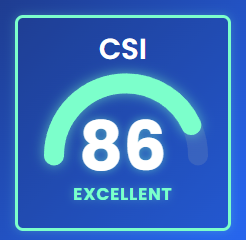
The CSI is built so that one impressive number can't hide a dangerous flaw — great returns can't buy a strategy past dangerous losses.
Safety Checks
Beyond the score itself, the CSI includes circuit breakers: hard safety rules that force a Failed verdict when a fundamental problem is detected, no matter how good everything else looks. The Quality Report names the breaker that fired, so you always know why.
The conditions the CSI guards against:
- Excessive drawdown — severe capital loss disqualifies a strategy regardless of other metrics
- No real edge — if the strategy doesn't actually make money over its history, it fails
- Unrealistic win rate — a win rate implausibly low or implausibly high usually points to a data or construction problem
- Too good to be true — returns or risk-adjusted returns far beyond what sustained real-world trading achieves, or an equity curve too smooth to be real, are treated as signs of look-ahead bias or curve-fitting
The CSI also raises quality warnings that flag concerns for manual review without changing the verdict.
Info
Not enough trades? Below a minimum number of trades, the CSI isn't calculated at all — it shows Not enough data (in gray) rather than a misleading number. Import more trade history to get a score.
CSI tiers and status
The CSI maps to four tiers. Status labels describe validation and monitoring posture — not how much capital to deploy (that is your decision outside AlgoChef).
| Tier | Score Range | Status |
|---|---|---|
| Excellent | 80–100 | Tradable — strong overall quality; keep validating |
| Good | 60–79 | Tradable — solid with standard monitoring |
| Caution | 40–59 | Monitor closely — elevated uncertainty |
| Failed | 1–39 | Do not trade — fails quality bar |
A score of 0 is not a Failed score — it means the CSI hasn't been calculated, usually because there aren't enough trades yet.
Tip
Low CSI? Look at the related scores — Profitability, Risk, and Confidence — and the Quality Report's warnings. They often point to where a strategy is struggling.
Why is my score low when my metrics look fine?
The CSI isn't an average of the metrics you see on the dashboard, and no single dashboard metric maps one-to-one to it. It's a proprietary judgement of overall quality, built to reward strategies that are strong — not merely acceptable — where it matters most for surviving live trading.
That means a strategy where every visible metric looks acceptable can still score in the middle of the range. Acceptable across the board doesn't mean strong across the board.
Info
It's hard to hit the Excellent tier, and even harder to score in the 90s. A strategy with great returns but poor risk management won't score well. A strategy with great stats on a short trade history won't score well either. That's by design.
How is the score calculated?
The CSI evaluates many validation checks on your full trade history and turns them into a single verdict, using a proprietary formula. On top of that sit the circuit breakers described above, which catch extreme conditions like excessive drawdown, no real edge, or results that look too good to be true.
Think of it like a credit score: you know the rating scale and you broadly know what helps or hurts it, but you don't know the exact formula or weights behind it — and you don't need to. What matters is that the methodology is sound, consistent, and applied the same way to every strategy.
Same philosophy here. The tiers (Excellent, Good, Caution, Failed) and the circuit-breaker conditions are fully transparent. The internal formula and weights are not — and that's intentional.
How Robust Is Your CSI?
The Monte Carlo Simulation tests whether your CSI stays stable across thousands of randomized scenarios. If the tier holds up (e.g., stays "Good" in 90%+ of simulations), your edge is robust. If it drops to "Caution" or "Failed" under randomization, the backtest may be misleading.
Tip
Ready to see your CSI? Start your 14-day free trial.